
Of all the plumbing problems a homeowner can run into, sewer line issues are probably the most stressful. They're underground, you can't see them, and the warning signs are easy to brush off until suddenly there's sewage backing up into a tub. By that point, what could have been a manageable repair has usually turned into a much bigger job.
If you live in Canton, Woodstock, Holly Springs, Ball Ground, or anywhere else in Cherokee County, this guide walks through the actual signs of a sewer line problem, what causes them in this specific region, what repair or replacement involves, and what it typically costs. The goal is to give you enough information to know whether what you're seeing is normal, mildly concerning, or something that needs a plumber out there today.
Why Sewer Lines Fail in Cherokee County Specifically
Most sewer line content online is generic, written for any city in America. But sewer failures here have some specific regional drivers worth knowing about.
Georgia red clay soil: The dense clay soil across North Georgia expands when it's wet and contracts when it's dry, and it goes through that cycle multiple times a year. That constant movement puts steady pressure on buried sewer lines, gradually stressing joints, shifting pipe sections out of alignment, and creating cracks where roots can get in.
Mature tree canopy: Cherokee County has a lot of established tree growth, and tree roots are aggressive about finding moisture. Oak, pine, sweetgum, and other species send roots into any gap they can find in a sewer line, and once they're in, they grow into dense mats that block flow completely.
Aging infrastructure: Homes in this area built before the 1970s often have original clay tile or cast iron sewer laterals. Clay tile was widely installed from the early 1900s through the 1960s and was never designed to last forever. The mortared joints break down over decades, creating exactly the entry points roots and groundwater are looking for. Cast iron lasts longer but corrodes from the inside, eventually developing rough internal surfaces that catch debris and accelerate failures.
If your home is older or has mature trees in the yard, you're already in the higher-risk category for sewer line issues. That doesn't mean failure is imminent, but it does mean the warning signs deserve attention when they show up.
Six Signs You Might Have a Sewer Line Problem
A single slow drain is usually just a localized clog in that fixture. But when several drains in the house slow down or back up at the same time, the problem is almost certainly farther down the line, in the main sewer lateral.
The classic version of this is the toilet bubbling when the washing machine drains, or the shower backing up when someone flushes upstairs. Water is trying to leave the house but can't get past the blockage, so it finds whatever path it can.
When to call: Right away. Multi-fixture backups mean the problem is in the main line, and it's only going to get worse until someone clears it.
2. Sewer Smell in or Around the House
A healthy sewer line is sealed and odorless. If you're smelling sewage somewhere in the house, in the yard, or near a cleanout, the line is no longer sealed. There's a crack, a broken joint, or a failed seal somewhere allowing gas to escape.
When to call: Sewer gas is unpleasant, but it can also indicate methane buildup, which is a real health and safety issue. Worth getting someone out to find the source.
3. Wet Spots, Sinkholes, or Unusually Green Grass in the Yard
If part of your yard is suspiciously soggy when nothing's been watering it, or there's a patch of grass that's dramatically greener than the rest, that's usually a sewage leak feeding the soil from below. In severe cases, the soil can erode and create actual sinkholes or depressions over the line.
When to call: Any unexplained wet area in the yard over the sewer route is worth investigating. The earlier this gets caught, the less expensive the repair tends to be.
4. Gurgling Sounds From Drains or Toilets
If your drains or toilets are making gurgling or bubbling noises during normal use, air is escaping through the water in the trap. That usually means there's a partial blockage in the line creating pressure changes.
When to call: It's not always an emergency, but it's a sign something is starting to go wrong. Worth getting a camera inspection to see what's happening down there before it becomes a full backup.
5. Slow Drains Across the Whole House
One slow drain is a clog. Slow drains everywhere is almost always a sewer line problem. When the main line is partially blocked, water from every fixture has to fight to get out, and the whole system feels sluggish.
When to call: Same as multi-fixture backups, just earlier in the timeline. Catching it at the "slow" stage instead of the "backing up" stage saves a lot of mess.
6. Sewage Backing Up Into the House
This is the one nobody wants to deal with. If raw sewage is coming up through a tub, shower drain, floor drain, or toilet, the main sewer line is fully blocked and water has nowhere to go except back into the house.
When to call: Immediately. This is a same-day emergency. Beyond the obvious damage and health concerns, every minute the backup continues makes the cleanup worse.
What Causes Most Sewer Line Failures Here
Most of the calls we run in Cherokee County come down to a handful of root causes:
Tree root intrusion: Roots get into the line through any weakness — a joint, a crack, an old seal — and grow into mats that block flow. This is probably the single most common cause in older homes with mature landscaping.
Pipe collapse or breakage: Clay tile and old cast iron pipes can crack, separate at joints, or partially collapse over time. Once the structural integrity of the line is gone, everything else gets worse fast.
Grease and debris buildup: Over years, grease, soap scum, and food waste coat the inside of pipes and gradually restrict flow. This is more of a slow-creep problem than a sudden one.
Ground shifting: Georgia's red clay expansion and contraction shifts pipe sections out of alignment, creating offsets, separations, and sags where waste gets stuck.
Improper drain use: Wet wipes, paper towels, hygiene products, and grease poured down drains are some of the more avoidable causes. None of these break down the way they need to in order to pass through a sewer line cleanly.
What Sewer Repair Actually Involves
Depending on the situation, sewer line repair can range from a relatively quick fix to a multi-day job. Here are the main options:
Drain cleaning: For partial blockages caused by roots or buildup, mechanical clearing (snaking) or hydro jetting can often restore flow without any digging. This is the cheapest, fastest option when it's appropriate, but it doesn't fix structural problems.
Camera inspection: Before any major work, a sewer camera goes down the line to see exactly what's wrong and where. This step is essential. Without it, you're guessing.
Spot repair: If the line is mostly sound and the damage is localized, a single section can be repaired or replaced without doing the whole run. This usually requires some digging, but only at the damaged spot.
Full replacement: When a line is failing in multiple places, has reached the end of its material life, or has structural damage too significant to spot-repair, the whole line needs to come out and a new one needs to go in. This is the bigger job, sometimes involving heavy equipment depending on the depth and length of the run.
Trenchless options: In some cases, pipe lining (a new pipe formed inside the old one) or pipe bursting (a new pipe pulled through while breaking up the old one) can replace a sewer line with minimal digging. Trenchless methods cost more per foot but save significantly on yard and driveway restoration. Worth considering when the alternative is tearing up landscaping or hardscape.
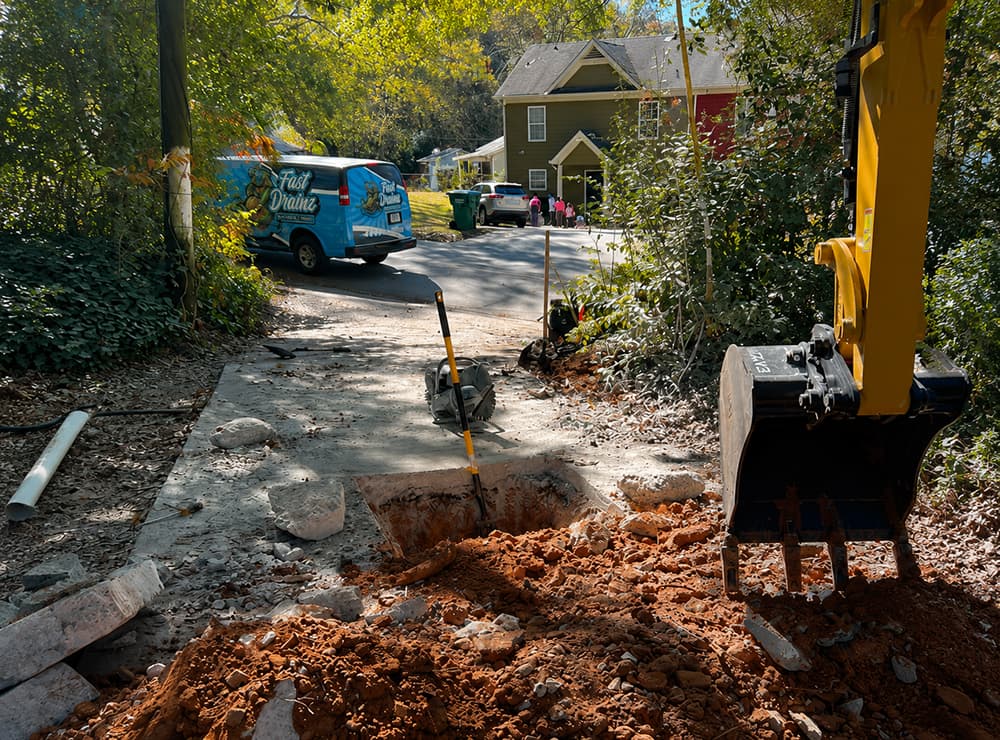
We recently had a sewer line interruption in Cherokee County where the line had failed badly enough that we needed real digging equipment to get to it. With the help of Jordan and a tractor, we got it dug out, the damaged section replaced, and the customer back to normal in a single visit. Sometimes the job is more digging than plumbing, but that's just part of what sewer work looks like when a line has been quietly failing for years.
Typical Sewer Line Repair Costs in Cherokee County
These are industry ballpark ranges, not Fast Drains-specific quotes. Real numbers depend on the specifics of your line, depth, length, and material.
The huge range on full replacement comes down to length of the line, depth, what's on top of it, and whether trenchless is an option. A short, shallow run in an open yard is on the low end. A long, deep line under a driveway with mature landscaping above it is on the high end.
Repair vs. Replace: How to Decide
Sewer line decisions usually follow a simple logic:
Cleaning or snaking is enough when: The line itself is sound and the problem is a buildup or root incursion that can be cleared.
Spot repair makes sense when: The damage is localized to a single section and the rest of the line is in good shape.
Full replacement is the right call when: The line is old enough that the material is failing across the whole run, you've had repeated repairs in different spots, or a camera inspection shows multiple structural issues. Spending money on patches for a line that's about to fail again somewhere else isn't actually saving money.
A camera inspection is what makes this decision clear instead of a guess. Without seeing the actual condition of the line, anyone telling you what you need is speculating.
When You're Not Sure, Get It Checked
Sewer line problems are easier and cheaper to handle the earlier they're caught. Slow drains, occasional gurgling, or a single backup are warning signs that something is starting to go wrong. Once sewage is in the house or the yard is sinking, the timeline gets a lot shorter.
Fast Drains Plumbing has been serving Cherokee County and surrounding North Georgia for over 25 years, with more than 150 five-star Google reviews and a 100% satisfaction guarantee on every job. We can come out, run a camera, find the actual problem, and walk you through your options honestly. No pressure, no upsells, just a straight answer.
Give us a call at 470-680-7863 and we'll get you scheduled.
Frequently Asked Questions
Q: How long does a sewer line repair take?
A: Drain cleaning and snaking usually take an hour or two. Spot repairs can often be done in a single day. Full replacements with traditional excavation typically take one to three days depending on length, depth, and restoration work needed.
Q: Can a sewer line be replaced without digging up the yard?
A: In many cases, yes. Trenchless methods like pipe lining and pipe bursting can replace a sewer line through small access points instead of a full open trench. It costs more per foot but saves significantly on landscaping and driveway restoration.
Q: How long do sewer lines last?
A: It depends on the material. PVC can last 50-100 years. Cast iron usually lasts 75-100 years but can fail earlier in corrosive soil. Clay tile typically lasts 50-60 years before joint failure becomes a problem. If your home is older than 50 years and still has its original line, you're in the range where failure becomes more likely each year.
Q: What's the difference between a sewer line and a drain line?
A: Drain lines are the smaller pipes inside the house that carry waste from individual fixtures. The sewer line (or sewer lateral) is the main line that runs from the house out to the public sewer or septic system. When people talk about "sewer line repair," they usually mean the main lateral.
Q: Is sewer line repair covered by homeowners insurance?
A: Usually not for normal wear and tear, root damage, or age-related failure. Sudden catastrophic damage from a specific event might be covered. Worth checking your policy, but don't assume it'll be covered.
Q: Do you offer same-day sewer line service in Cherokee County?
A: For emergencies like active backups, yes. Diagnostic work and inspections can almost always be done the same day. Full replacements require more scheduling depending on the scope of the job, but we move as quickly as the work allows.